note : *This will be the fourth part of talking about the different courts in the UK . I didn’t want to cram all of this into one post , so i decided i would split it into different part . This will help me to get a better understanding of all the courts , rather then me getting brief knowledge about each court .*
Summary of the Previous Blog on the Judicial System in the United Kingdom
Previously on the last post i looked at 2 types of courts which were Crown court and the High court . The Crown court falls into the category of a Criminal court . The crown court would tend to deal with indictment offences which in simple terms they deal with serious offences like murder , rape or robbery . Crown court also has 2 types of judges similar to the County court , which are either a circuit judge or a recorder . In the Crown court they can give a range of sentences such as community sentences , prison sentences or life sentences . The Crown court also deals with appeals that are made by the magistrate court , magistrate cases can be passed to crown court for sentencing or longer sentencing .
I also look at High court which falls into the civil court category . This court is divided into three division that being family division , chancery division and the queens benches division . In the summary the family division deals with family related manner e.g divorce,child custody , adoption and other cases related to family manners . The chancery division in summary deals with cases such as equity , trusts , property law , intellectual property and matters related to businesses and corporation . Lastly the Queens bench division in summary deals with civil cases such as contract disputes , personal injury claims and it also does judicial reviews which are legal process that court reviews decisions made by public authorities to ensure they are lawful and fair . Not to forget that the High court has 4 types of judges which are high court , lords justices of appeal , masters and registrars and specialist judges .
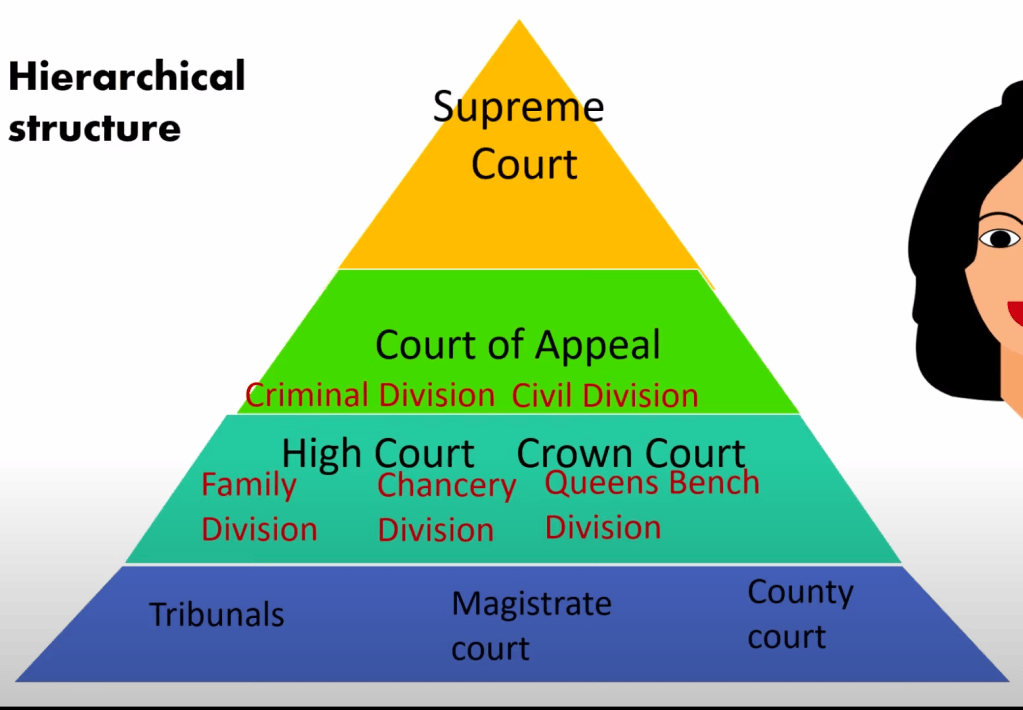
Court of Appeal
This court is the second-highest court in the legal hierarchical system . If you look at the were the Court of appeal is you can see that both the high court and crown court fall beneath it in this hierarchy presented . In the Court of appeal it consists of two division which are the Civil division and the Criminal Division each of these divisions handle a respective of type of cases . This court has only one type of judge but it is depends on what gender you are on how you would be classed . In simple words if you are a male you would be called the Lords justices of appeal while if you were a female you would be refereed to as the Lady Justice of appeal . The appeal process is quite easy to understand as the Court of appeal will listen to the appeals made by lower courts (e.g from the high court , crown court and certain tribunals) , the court of appeal will review these courts decisions on points of law or procedure rather than re-evaluating evidence . Appeals are usually heard by a panel of three judges , through important or complex cases may be heard by a larger panel . The court deals will a wide range of case which include civil disputes , criminal appeals , family law matters and challenges to the decisions of regulatory bodies . Appeals can be made by lower courts if the believe that there has been an error made in the application of the law or in legal procedure during their trial . However while the court of appeal is the key avenue for appeal , its decisions can still be further appealed in exceptional cases to the supreme court , which will be the final court of appeal in the UK and the last court i will speak upon in my blog .
 study.blog